Biochar Basics
Do you know how to make a 95F degree day feel hotter? Build a giant fire and make biochar! It probably isn’t the best time of year to be making this awesome amendment, but here I am having a good old time burning up some scrap wood and making buckets of one of the most amazing soil building materials.
Have you ever found those black charcoal chunks left over in a wood fire? If so, you have accidentally made biochar. It is pretty much just a chunk of carbon that is left over after all of the organic materials have been burned out of a piece of wood. But what is most amazing about it is the surface area left behind. It doesn’t look or feel like much, but there are thousands of square feet of surface area in that little light chunk.
Biochar is incredibly porous and the structure is honey comb. I like to imagine a fresh piece of biochar as a large unoccupied condominium. The walls are there, but the whole thing is empty and just waiting on occupants to move inside. But just who is moving in to our biochar? Well, it can be either nutrients or microbes or water. But in my case, I want to fill these microscopic openings with microbes and moisture.
The water holding capability of biochar is great. It can hold seven times its weight in water. So one pound of biochar can hold seven pounds of water. But a tiny amount can also hold millions of bacteria. Do you remember that we actually want bacteria living in our soil as they are what truly feed our plants? The bacteria break down the nutrients in the soil and make them bio-available for our plants to take up.
In order for those bacteria to get in there we need to charge or inoculate the biochar. We do that by mixing it in with the compost long before the compost goes on the pasture or in the garden. If we were to put the biochar straight in the garden or onto the pasture, it would suck up much of the available nutrients and hang on to them. Instead, we want to fill it with bacteria first. The “empty” chunks will get mixed in to the compost pile where the bacteria will fill the holes over the next few weeks while the raw compost material breaks down to become soil.
While the compost breaks down, the biochar doesn’t ever go away. It’s hard to imagine, and I think the researchers are just guessing at a number, but they say that it has a life span of thousands of years. Explorers and archeologists have uncovered giant mounds of earth filled with biochar in the Amazon forests. This “terra preta” as it has been named, was thought to have been intentionally made by the first people that lived along the banks of the Amazon River and buried in the ground to help them grow better food.
And that is what will eventually happen to it here. Once the current pile of compost is done breaking down, I will either add it to my garden beds or spread it on the pasture. In doing the research about it last week, I found a really neat way of getting it down into the soil in the pastures. Researchers and farmers have found that feeding it to cattle and letting it pass through their digestive system inoculates it with bacteria. Then once the cows poop it out, the native dung beetles come along and bury the poo, biochar included.
I wasn’t sure if we even had that many beetles, so I took a little walk through the pasture, really inspecting the cow plops. Sure enough, there are little mounds by almost every single pile and I even spotted beetles working. I got to thinking that it would be neat to be able to identify these beetles, so I ordered an insect field guide. Well, I sure learned a lot in the little bit that I have read it so far. Mainly that there are many more insects than I could ever truly know. It turns out that there are over 29,000 different species of beetles in just North America alone. So, I will have to be content with just recognizing the few that I have here.
What’s really wild to me is the speed at which they all show up to the pile of dung. It’s like they are just hanging out in the soil, waiting to be needed. And what are they eating and doing when there aren’t cows dropping gifts from above? I saw two species of beetle at a pile that had been on the ground for less than 3 hours. One was a rainbow scarab beetle, kind of easy to recognize because of the shimmery rainbow color and the other was a little ½” long dull black fellow. The rainbow scarab was quite shy and scurried back in his hole when I walked by, but the little fella just kept working and wasn’t bothered at all by my presence.
So how do you make biochar? It’s pretty simple, although there are books out there on the subject and the authors would probably argue that it’s not that easy. The idea is to burn the wood material without burning it all up. Building a fire in a low oxygen setting is the key to now allowing it to burn to ash. Once it gets to ash, it’s no longer got the structure we are looking for.
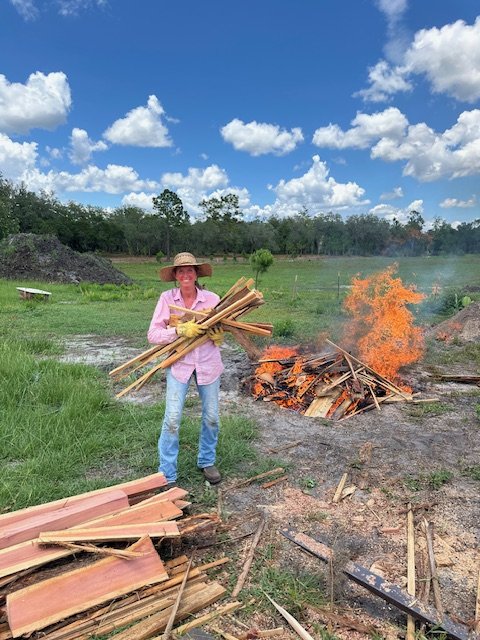
I dug a hole with my tractor, a bucket width wide and just far enough across that I didn’t drive in it with my front tires. Then I build a fire in the bottom of the hole. You can use a wide range or woods or organic materials, but I used the excess pieces left over from our sawmill friend cutting lumber recently. It was mostly cedar and cypress, cut into 1” thick pieces, with differing widths and lengths. Brian used the big chainsaw and cut it all into about 3 or 4’ lengths so that I could handle it easier.
Then I built up the fire, adding more wood each time the top layer got a gray ash covering. I was pretty much just trying to smother the fire beneath each time it all caught all the way through. Burning wood in this low oxygen setting is called pyrolysis. This took about an hour or hour and a half to fill the hole completely. Then I doused it with water, both from a hose and a 250-gallon IBC tote that we had on standby.
Putting out the fire quickly and with water creates a lot of steam and this helps create the final porous biochar product. If we put it out too slow, or let it burn itself out, we would end up with more ash than black chunks. When done right, the result is a light weight, brittle piece of carbon that we will bust up into smaller pieces for ease of use. The stuff that will go into the compost pile doesn’t need to be very small, I think just ½” to 1” is fine.
For the cows I ground and sifted some that is under ¼” in diameter. I added it to their feed at the rate of about 150 grams per cow. They weren’t put off by it, but did slow down on their eating on the 3rd day. So, I will cut back on how much I add and also only add it in every few days. You can feed too much and cause detriment to your cows, so it makes sense to go light.
There are several other benefits to using biochar, but these are my main reasons for using it for now. It’s pretty neat that something many of us have made by accident has such benefits if handled correctly. Until next time, keep learning and growing!